I am so incredibly excited to share that today’s post is my 25th!! It feels like it was only a few weeks ago that I shared how proud I was about my 10th post. It has been such a fun ride creating these reflections, and I hope they’re offering some context for topics that many of us find relatable.
Today I’m writing about the film Calvary, directed by John Michael McDonagh. It’s a five-star movie for me, so it feels like the perfect pick for a milestone blog post. It’s the story of Father James Lavelle – a Catholic priest pastoring a small community in present-day Ireland – who, in the first scene, is told by a parishioner in the confessional that they plan to kill him in a week, on the following Sunday. It’s retribution for years of childhood sexual abuse by a bad priest – but no one would care about an abuse victim killing a bad priest, he says, so he wants to kill a good one instead. Calvary follows Father Lavelle over the course of this week as he attempts to carry on like normal, uncertain whether the parishioner will follow through with the threat.
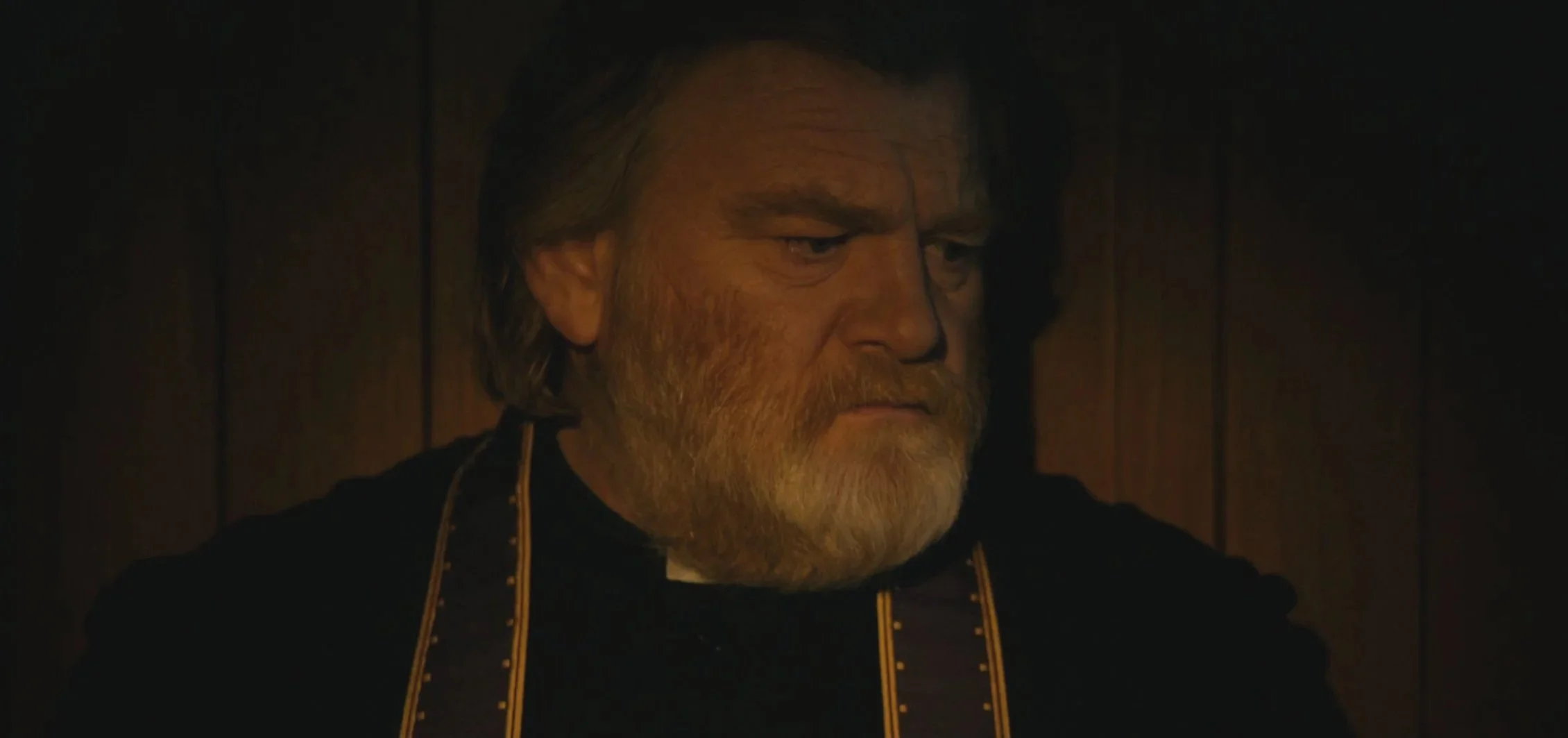
Father Lavelle receiving the death threat that begins his week
The increasing level of stress Father Lavelle endures as the week progresses brought to mind a therapy concept I talk about with my clients often: window of tolerance. Most of my clients have heard me talk about window of tolerance because I specialize in relationships and trauma work, and it’s a big factor in both types of therapy.
If you've ever wondered why you overreacted to something small – yelling at your kids over nothing, giving someone the finger in a traffic jam, blowing your lid over a situation that didn’t seem to warrant it – this post might clear up why it happened.
I try to avoid writing lengthy definitions in my blog posts, but window of tolerance is a lesser-known concept, so I’m going to provide more detail than usual. Then I will come back to my discussion of the film and to my explanation of why we sometimes have that feeling of “I don’t know what came over me, my reaction made no sense.”
what is window of tolerance?
Window of tolerance is the idea that all of us have a comfortable operating place where we feel like ourselves, we can think clearly, connect with others, and we can make plans. One of my very favorite trauma textbooks, Nurturing Resilience, describes window of tolerance as “the optimal window within which we can respond to a stimulus without becoming overly aroused, and then be able to settle naturally” (p. 121).
what happens when we’re outside our window of tolerance?
When we’re outside of our window, that’s when we can feel emotionally flooded, or dysregulated. It might look like outwardly emoting in a big way, or it might look like shutting down – like how I described in my post about complex trauma. When we’re outside this window, that’s when we say things we don’t mean or we yell or may appear to stonewall others. It could even look like circling thoughts you can’t shut off, which I like to think of as the hamster-wheel effect. We can’t think clearly, and trying to be productive is a no-go. When we do things we later regret and can’t articulate why we did them in the first place – it usually means we weren’t operating within our window of tolerance.
how wide is everyone’s window of tolerance?
Everyone’s window has a different width, so someone with a really wide window is generally able to stay in that comfortable place where they feel calm and safe, which is a way of describing what it means to be emotionally regulated. Someone who has been through really hard things and hasn’t had the opportunity to heal from them may have a more narrow window. And “hard things” could be like going through something traumatic, or it could be something like physical illness.
But – and this is the part that’s relevant for our everyday experience of life and for my discussion of Calvary – all kinds of other factors impact how wide our window is from moment to moment. Things like being hungry, being sleepy, sensory overload, having an upsetting conversation with our mom, having a bad sunburn, listening to a crying baby all day, hormonal changes, travel days, and all of the zillion other stressors we all experience on the daily…plus all of the good stuff that can deplete us like a great party, getting married, having a long and connecting conversation – all of these factors can influence our how wide our window of tolerance is. Not long-term necessarily, unless the stressors are chronic, but still enough influence to where we can feel the difference compared to how we usually feel.
The more you’re holding, the more narrow that window becomes. And the more narrow, the easier it is to leave your window of tolerance. In other words, the more stressors we endure, the easier it is for one of these stressors to push us over the edge.
how to have a meltdown
Father Lavelle in Calvary does indeed reach a point where he loses it, and it seems out of character for him. I think most of us can relate to that moment. How did it happen for him? And how does it happen for the rest of us?
We don’t get to see how even-keeled Father Lavelle is before his very stressful week begins, but what we know about him suggests he’s relatively chill most of the time. We know he’s generally well-liked by the community, and his parishioners believe him to be a good priest. We also know that people open up to him pretty regularly and easily, which indicates long-term emotional availability to them, not just something he’s starting this week. We also know he and his adult daughter are close and have a positive relationship. All of this connection, to me, suggests that Father Lavelle is generally bopping along within his window.
We also know that being a good priest means carrying heavy emotional burdens on a daily basis, both in and out of the confessional. And of course we know from scene one – someone has recently threatened to kill him. Father Lavelle opts out of sharing the death threat with anyone except his bishop, so he’s not receiving any social support which theoretically could have offset some of this stress.
In summation, what we know about Father Lavelle’s baseline heading in this week is that he’s generally staying in his window of tolerance – he authentically keeps his composure well. But he’s also carrying stressors that may impact the width of his window, meaning the distance between a meltdown and how he’s feeling in any given moment may be shorter than what’s normal for him.
Fast-forwarding, when Father Lavelle does indeed snap and lose his temper, the snap happens Friday evening when he gets extremely drunk, shoots at the bar where he’s drinking (like with a handgun, I’m not being metaphorical here), then pisses off the barkeep enough to where they end up getting into an actual brawl. Father Lavelle goes home having been beaten by a baseball bat, and when he arrives, he berates the other priest from his parish. Rough night.
He didn’t just daintily step outside his window, it was more of a cannonball. What happens to this well-regarded priest between Sunday when he receives the death threat and Friday when he gets into a physical altercation? How did he end up behaving so unrecognizably from his normal, everyday self? Let’s start from the top and figure it out.
the small stuff that adds up
On Monday, Lavelle makes a visit to Inspector Stanton, the local law, and Stanton has a visitor: a male sex worker named Leo. Leo clearly loves the shock factor of being open about the logistics of his profession and doesn’t hold back in front of a priest. In this interaction and in another with Fitzgerald, the town rich guy, their blatant disrespect for Lavelle is palatable.
It’s a common thread running throughout every day of the week: people give Father Lavelle a lot of shit. Some of it is good-natured ribbing, but much of it not so much. Some of it is a clear cry for help, some of it is just people being jerks. Much of people’s ridicule seems less about Father Lavelle, per se, and more about disillusionment and anger toward the Catholic Church (and since it’s Ireland, Catholicism is pretty much the water they’re swimming in). And as a Catholic priest, he’s obviously an easy target for these feelings.
All that’s to say, it’s basically business as usual for Father Lavelle to be tasked with holding people’s anger toward a larger system. It’s a stressor that he’s equipped to handle usually, but it increasingly grates on him day by day. Some possible equivalents for people who aren’t priests would be kids teasing their teacher all day, toddlers climbing on their parents constantly, the next door neighbor talking at you every time you open your front door, or a daily hour-long commute in both directions. Most of us have some version of a metaphorical buzzing mosquito always hanging around in the background that we can ignore when things are fine, but feel like torture when life feels like a lot.
The daily low-grade mocking isn’t the only emotional weight that’s part of Father Lavelle’s normal routine. Even with the possible end of his life looming, Lavelle doesn’t neglect his duties to his parishioners. He still makes the rounds, spending much of the week focusing his spiritual care efforts on a woman who received Sunday Eucharist wearing sunglasses, Veronica. He suspects she may have been hiding evidence of abuse by her husband. After speaking to her, he discovers she does indeed have a black eye, but he also comes to understand her marriage is on the rocks in more ways than one – Lavelle is unable to convince Veronica to tell him whether it was her husband who perpetrated the abuse or her lover.
Basically, just business as usual as he pastors his parish.
why did he overreact to something so small?
Were Father Lavelle only carrying a death threat, ongoing mocking, and the spiritual care of a complicated and abusive love triangle, I think that would be enough. That’s plenty of stress for one week. That’s plenty of explanation for a pacifist to end up in a bar fight. But alas, this is no ordinary week. Here are the high points that crop up the rest of the week:
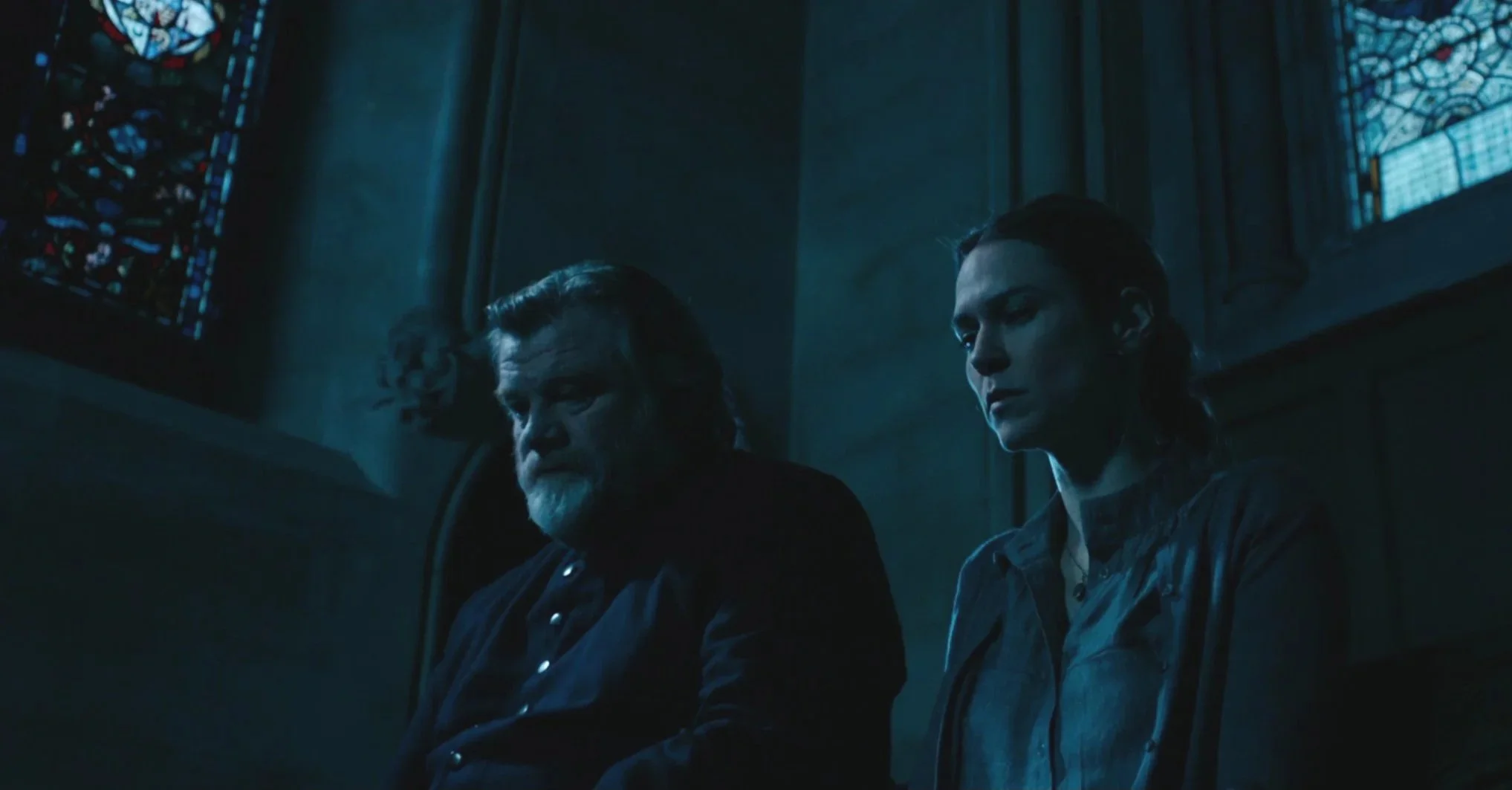
Father Lavelle sits with a young widow when her husband passes.
Monday: Father Lavelle’s daughter Fiona comes to visit. She plans to stay for a few days, having just survived a suicide attempt and is in need of her dad’s love and support.
Tuesday: He performs Last Rites for a man dying in the hospital from injuries from a car accident. Lavelle then spends the evening sitting with the man’s young widow while she processes what she just lost.
Wednesday: A former pupil of the priest has requested a visit. The pupil is one Freddie Joyce, an incarcerated serial killer cannibal who deceived the priest into a visit and only wanted to reflect on his crimes rather than engage in any repentance.
Also Wednesday: Someone burns down the church.
Thursday: Someone intentionally kills the priest’s dog, Bruno, so Lavelle spends his evening burying his beloved companion.
Friday, the last straw: As Lavelle walks down the road, he passes a young girl on a stroll. They engage in pleasantries with each other as they walk by each other – then the girl’s father arrives and yells at the priest, implying misconduct, then speeds away in a car. It’s the final interaction for Father Lavelle before he heads to the bar to get drunk which leads him into the eventual brawl.
when one more thing is too much
I share each of these moments not to provide a summary of the film, but to demonstrate the immense pressure that was building for this otherwise genial, composed man. I found the last incident with the girl on the road particularly affecting. It reminds me of a time I got into a fight with my vacuum cleaner after a hellish week: I managed to keep it together for days upon days of big, impactful stressors, only to be defeated by a tangled vacuum cord which resulted in me, quite comically, sobbing on my floor while my roommate – perplexed by an outburst from someone he’d rarely ever seen in a bad mood – stood by and watched, uncertain what to do. I just couldn’t deal with one more thing, even though that one thing could not have been more trivial. And Father Lavelle couldn’t deal with one more thing either, even though it was such a small thing to overreact to compared to the dramatics of everything else he was carrying.
When I try to explain my approach to working with clients, I’ll often say something like “people make sense in context.” When Lavelle got into the brawl at the bar, bystanders were likely shocked by this behavior – but they had no context. Watching him go through the entire week and seeing every little thing that happened to him, I felt more like “Yep, about time.” It made total sense to me.
Getting into a physical altercation when you’re stressed is generally ill-advised, but figuring out how to prevent snapping in the first place is a topic for another day. For today, I hope you walk away feeling seen and able to grant yourself some compassion for those moments that feel out of place compared to your usual manner of being. We haven’t all had a week like Father Lavelle’s, but all of us have had a bad week. And most of us know what it’s like to do something we’re not proud of at the end of it – like crying over a vacuum cord or tearing a shirt to shreds after finding a small snag (both of which I have done).
Thank you for reading! I’m Trina, and I’m a therapist in Austin, Texas. I write about movies, TV shows, & other media that reflect the kinds of patterns, relationships, and questions my clients are exploring in therapy.
I wrote this post myself, drawing on my own ideas and clinical perspective. I occasionally use AI to help me with things like titles, keywords, and SEO. But the reflections are always mine.
If you’re in Texas and looking for therapy, I’d love to connect and hear more about your story.