what is complex trauma? the kid detective (2020) as a case study
This post is the first of two about the film The Kid Detective. Check out the whole series.
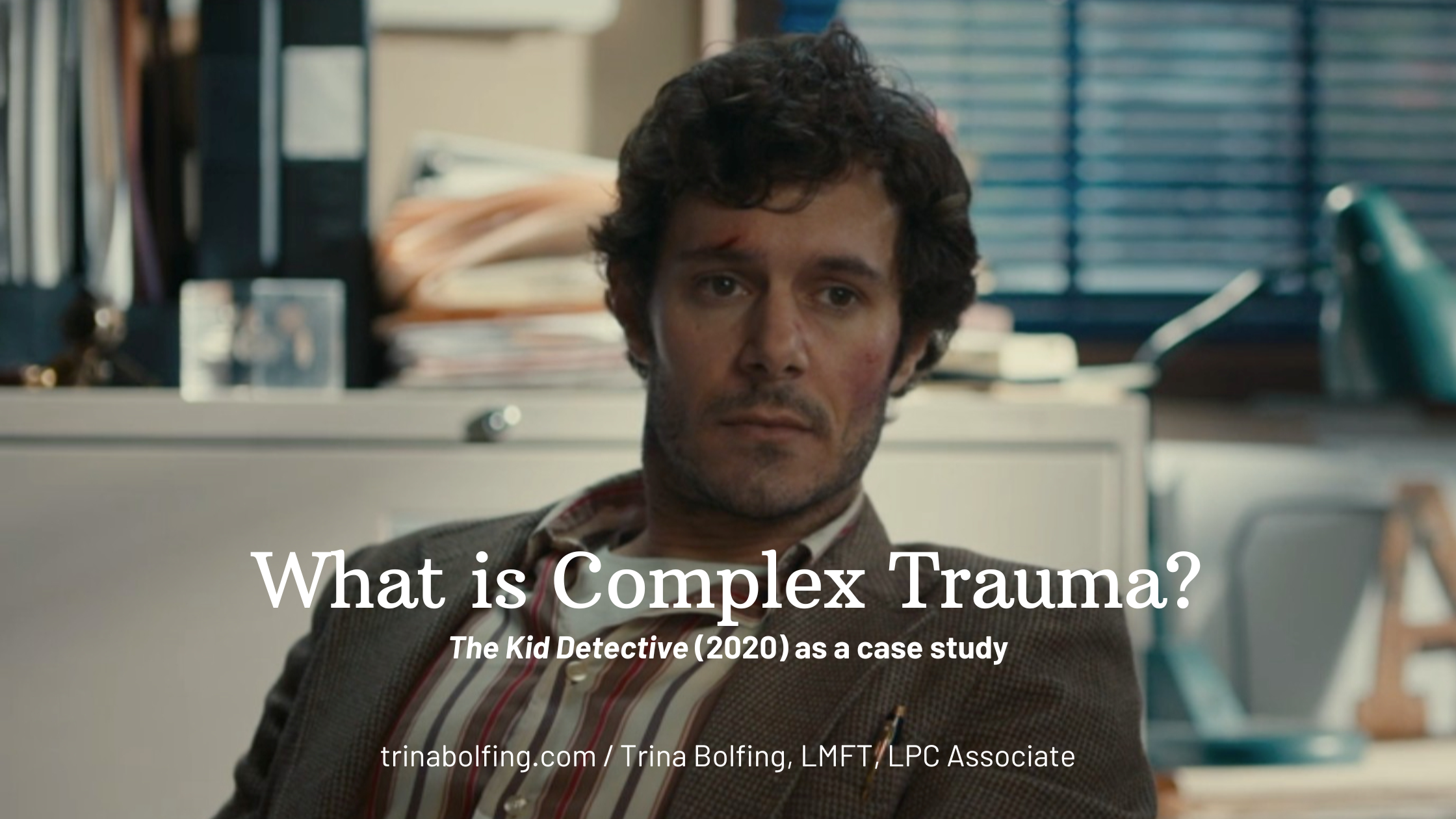
Hello and welcome! I’m excited to write about today’s film – The Kid Detective, directed by Evan Morgan – because it’s one that few people caught when it came out, so it’s always fun for me to introduce it to a new audience. I’m also excited about it because at its heart, this movie is about complex trauma – and it does a great job showing us what complex trauma can look like in real life.
By its very nature, complex trauma can be difficult to portray on screen: it’s hard to capture the full weight of chronic exposure to difficult things, plus demonstrate their long-term impact all within a two-hour window. The Kid Detective does a great job, though. Today’s post will be one of two on the film, so next week I’ll be discussing it again through the lens of the former gifted kid.
a story about complex trauma
The Kid Detective centers around Abe Applebaum, a man in his early 30s following his childhood dream of being a private detective in the small, fictional town of Willowbrook. It’s basically the story of Encyclopedia Brown, all grown up and having been knocked around by life, as life is wont to do.
This film is a dark comedy and a mystery, but you can also easily treat it as a complex trauma case study. Some films centering on trauma seem like they need to beat us over the head with it, like the filmmaker thinks piling on one terrible thing after another is the only way viewers will understand why a character’s suffering is justified.
when trauma isn’t obvious
Not so with The Kid Detective. A lot goes unsaid in this film, and choosing to sit with Abe’s suffering is optional. You can feel Abe’s pain. Or you can just follow the mystery and laugh when it’s time to laugh, rolling your eyes or cringing at how pathetic he has become.
It’s great filmmaking, but it’s also reflective of the silent suffering of the people all around us who aren’t using their words to tell us what they’ve been through. Instead, they’re showing us they’re traumatized the same way Abe does: with self-sabotage, substance abuse, and slowly sliding toward failure with no clear reason why.
what complex trauma can look like
In Abe’s first scene, it’s present-day, and all the trappings of arrested development and failure-to-launch are front and center. He’s in bed in the middle of the day, and his parents come to visit him, bringing groceries but aren’t sure where to put them because the kitchen is a disgusting mess. Unshaved, unkempt, wearing pajamas, Abe hosts his parents while they check in about his finances saying “You know we’re not bailing you out again.”
It’s clear this is the norm for Abe, not a slow start to the work week. He’s not doing great, and everyone knows about it. And unfortunately, no one is reading Abe’s life as a symptom of trauma, they’re reading Abe as an emotionally immature failure.

It’s clear that Abe isn’t living his best life.
In one scene of The Kid Detective, Abe visits his parents for a family dinner. His private detective business comes up, and one family member says “You know, we really admire that you’re still doing that. Sticking it out.” And when she says her next line – “It takes a lot of courage.” – there’s a shot of Abe’s uncle sharing a conspiratorial eyebrow raise/eyeroll with Abe’s dad. There’s no question that Abe’s family sees him as juvenile and sees his business as a joke.
the weight he carried as a child
As a 12 year-old, things were different. Abe was beloved by his entire town. He and his solved-mysteries were featured in dozens of newspaper articles, and he’s even gifted his own downtown office, paid for by the community.
As a 32 year-old, Abe still works out of that same office. He’s broke, no longer well-respected, and almost certainly an alcoholic. He’s living a half-life, and it’s no wonder why. The most critical mystery of his life has never been solved: the mystery of the disappearance of 14 year-old Gracie Gulliver. Young Abe was never able to find his friend Gracie nor uncover what happened to her, and he has been carrying the lost hope of an entire town on his shoulders since she vanished.
What I love about this film’s portrayal of trauma is that we don’t know anything about what happened to Abe between age 12 and age 32. We don’t need to know anything about what happens in those convening years because what he went through as a kid – shouldering the weight of responsibility for an entire town’s problems, big and small, then a close friend vanishing without a trace and that very same town expecting Abe to find her – that’s enough.
why abe’s story counts as complex trauma
There are many layers to what he has been through – which is exactly what complex trauma can look like. There’s the complex trauma of having far too much asked of him when he was so young. Then there’s the acute trauma of his friend going missing. Then there’s more complex trauma of waking up, day after day after day, not knowing where she is, knowing that his town is counting on him to find her. He has spent almost two thirds of his entire life carrying a sense of failure that he never found Gracie. Abe doesn’t need to have gone through much else in order to be pretty fucked up as an adult.
In one scene, 13 year-old Abe – standing in his kitchen, wearing rocket ship pajamas – receives a phone call from another child, Mindy Martingrove. Mindy asks “I was just wondering, how much longer do you think it’ll take you to find Gracie?” When he tells her he’s not sure, Mindy replies, “My mom told me not to tell you this, but we’re all really counting on you. I know you can do it.” Despite Mindy’s upbeat, trusting voice, it’s heavy.

Mindy’s phone call to a very young kid with way too much weighing on him.
when trauma gets misunderstood
The town of Willowbrook hits on some familiar small-town stereotypes: everyone knows each other, and there’s a general sense of naïveté in that no one can bring themselves to believe something terrible has happened to Gracie. Prior to this moment, the entire town has truly put all of their faith in Abe. The police even consult with him on cases. It’s an inappropriate amount of responsibility to place on the shoulders of a child.
It’s easy to dismiss the town’s trust as the work of movie magic, but there are so many children who bear the weight of responsibility far beyond their years. Kids coming from a neglectful home may find it their job to feed younger siblings, or those growing up in a high-conflict home may be tasked to keep the peace among the adults. It weighs on them well into adulthood, and it can be a mind-fuck to realize it’s not normal. The fictional town of Willowbrook may be a touch far-fetched, but Abe’s experience – and its impact – is not.
dissociation & emotional shutdown
Fast-forwarding to the end of the movie, it’s no surprise that Abe experiences redemption. No need to spoil the end with the details, but he re-gains the trust and respect of his community when he solves the mystery of the brutal murder of a local teen. But since this movie’s plot is actually about Abe’s trauma, finding the murderer isn’t what brings us closure.
“He’s not ready to feel what he went through, so he feels nothing.”
Throughout the entire film, Abe has a bit of a poker face. He’s matter-of-fact and dry in how he communicates – only very rarely does he emote, and almost exclusively when he’s drunk or high. In therapy terms, it’s classic dissociation. He’s not ready to feel what he went through, so he feels nothing.
what healing can look like
But in the last scene, there’s a breakthrough. It’s an echo of his first scene. His parents come to visit, and Abe is up and dressed, his kitchen lived-in but quite clean. Mom and Dad are not bearing groceries. The living room now looks like the home of an adult. Abe persists in his dry, flat affect as they chit-chat, mostly about his recent successes. “You seem tired,” his mom says. “Yeah, I’ve been having a little trouble sleeping….It’s nothing. The floor creaks at night.”
Then it happens. He just starts sobbing, seemingly out of nowhere. Suddenly the world is a different place for him because his familiar – miserable, yes, but still familiar – homeostasis has been interrupted by his change in circumstances. Holding it together is now no longer possible. And that’s the end of the movie.
complex trauma isn’t always obvious
When people are curious what complex trauma is, it often isn’t flashy, so it’s easy to overlook. It can look like depression or laziness. Or it can be completely hidden by coping mechanisms designed to fool you into thinking this person is doing just fine. Obviously Abe isn’t in this latter category. But maybe you or someone you love is. There are all kinds of ways that we carry the patterns of our past, and not all of them are serving us.
Complex trauma is an area in which I specialize. If now feels like the time to start healing from yours, I’m here and ready to listen.
Thank you for reading! I’m Trina, and I’m a therapist in Austin, Texas. I write about movies, TV shows, & other media that reflect the kinds of patterns, relationships, and questions my clients are exploring in therapy.
I wrote this post myself, drawing on my own ideas and clinical perspective. I occasionally use AI to help me with things like titles, keywords, and SEO. But the reflections are always mine.
If you’re in Texas and looking for therapy, I’d love to connect and hear more about your story.