Today’s post might be one of those reflections where I end with a shrug, where I have no real conclusions to offer and certainly no advice. It’s a reflection where I’ll sit with you in the curiosity of finding a middle ground between what’s good for us and what’s not serving us.
I occasionally run art therapy groups, and there’s an activity I sometimes use from the book Managing Traumatic Stress Through Art. It’s called “Establishing a Safe Place,” and the book says “This art experience helps you to create a drawing of an imaginary safe place that you can use as a tool to manage overwhelming stress.” It’s not dissimilar from the safe place resource used in EMDR, so this idea is pretty pervasive as a therapeutic tool.
the comfort of escape
Just like any therapy intervention, it works really well for some people and not as well for others. For the people that more deeply connect with it, I sometimes wonder how to communicate my feeling that using the safe place is a great idea – but that it shouldn’t be over used or be the only tactic for managing stress. Then I’m stuck with the question of what “overusing” this strategy even means. Where do you find the line? What’s the problem with using it too much? Who am I to decide whether my clients should or shouldn’t rely on it as much as they feel drawn to do so?
Today’s film – I Saw the TV Glow, directed by Jane Schoenbrun – felt like an hour and forty minute exploration of this very conundrum. There are, perhaps, spoilers ahead. But I Saw the TV Glow is a bit of an arthouse film, so the plot and its meaning are in the eye of the beholder in many ways.
when imaginary worlds feel safer
This film is the story of two teens, Owen and Maddy, who are transfixed by a TV show called The Pink Opaque. “Sometimes, The Pink Opaque feels more real than real life,” Maddy – a queer teen growing up in the 90s in an abusive home – tells us.
Owen has his own reasons for needing an escape into The Pink Opaque’s universe. There’s the obvious reason: his mother is dying of cancer, eventually succumbing to her illness and leaving him alone with an emotionally distant, controlling father. Owen also describes experiencing a sense of disconnection from his physical body – perhaps because he is trans, it’s difficult to say – which may be an additional reason for identifying heavily with the show.
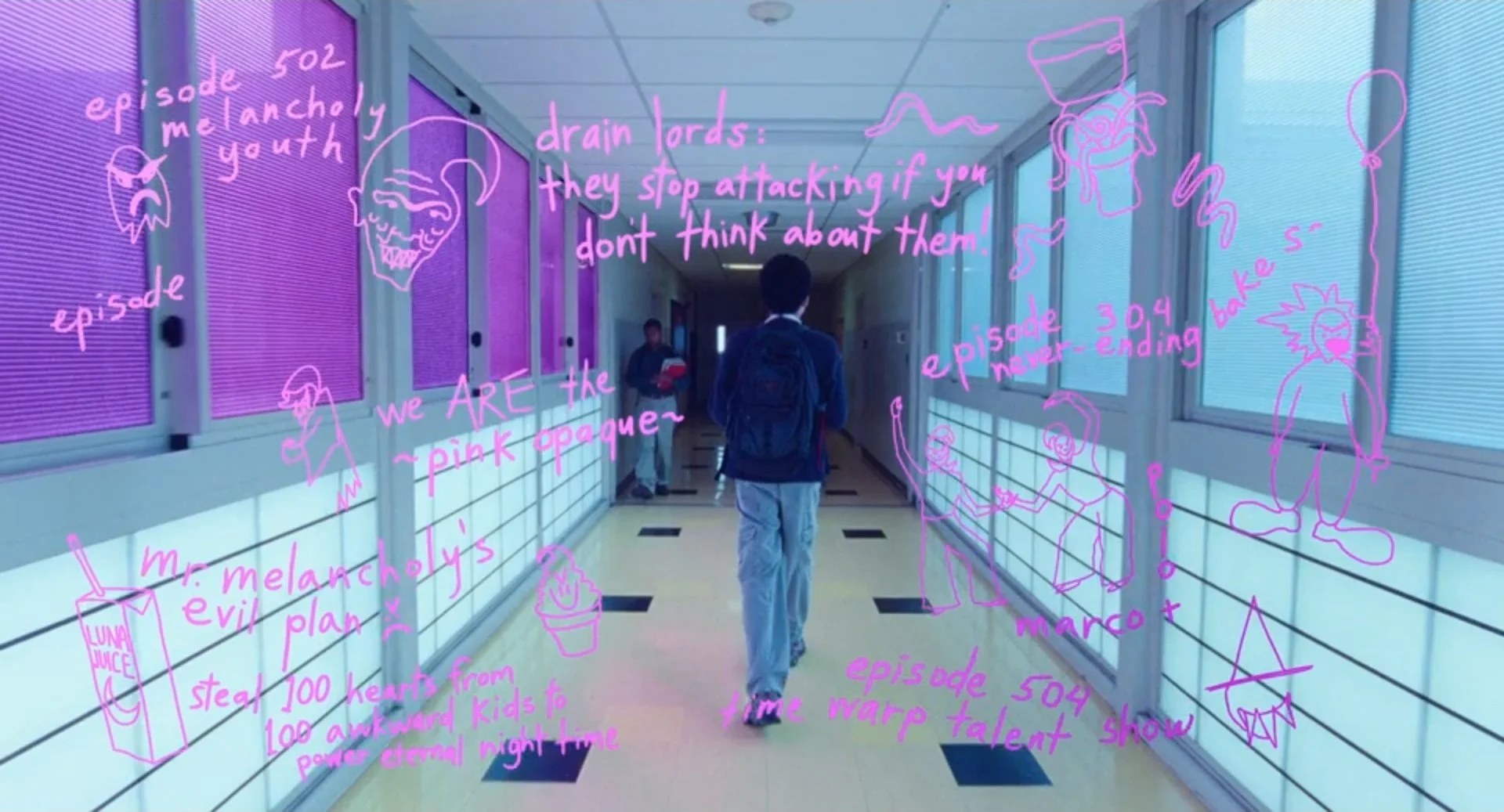
The Pink Opaque becomes a means of connecting with each other
Maddy eventually becomes convinced that she and Owen actually are the main characters of The Pink Opaque – Tara and Isabel. When she asks him if he remembers the show, Owen says it’s his favorite TV show of all time, to which Maddy responds “But are you sure that’s all it was?”
Owen is disturbed by what Maddy is suggesting, and ultimately they each go their own way, and he never sees her again. Regardless of whether Maddy is right, it is true that neither of them are living great lives.
Owen’s life is lonely and empty, almost unbearable to watch sometimes. He still lives with his dad, with whom he barely interacts. He goes to work at a job where he has no connection with his co-workers or other people, despite there being opportunity. Maddy’s life is a mystery, but we do know she doesn’t have anyone in it, sharing it with her.
when comfort turns into disconnection
The fantastical elements of this film do a great job painting a bleak and lonely picture without meaning or a story worth living. The film itself likely won’t land with lots of people because of how abstract it is. But the idea of escape is a concept most of us get. Most of us use escape as a coping mechanism, in some form or fashion. How many of us are able to articulate whether our chosen escapes are being helpful versus when they have become maladaptive?
After an emotionally or cognitively draining day, it can be unrealistic to expect ourselves to have the capacity to engage thoughtfully and intentionally with our surroundings. Watching a tried-and-true favorite can help revive us, giving our brains a rest. Scrolling through Instagram or TikTok offers the opportunity to turn off over-taxed parts of ourselves.
And yet, I have client after client sharing how troubling it is that they can’t seem to stop the re-watching or the scrolling. I myself have a bank of shows I’ve seen dozens of times and continue to re-visit while also wondering why I can’t motivate myself to try something new. There’s a strange discomfort in it because none of us is doing something wrong exactly. But over time, we recognize that we’re cutting ourselves off from something richer.
We could be creating something, connecting with our loved ones, immersing ourselves in something that feeds our creative brains. But the escapes – just like the imaginary safe space – call to us because we know exactly what they’ll give us. It’s emotionally regulating, which isn’t dissimilar from my recent reflection about how flattening complexity can do the same.
why predictable worlds feel comforting
In one scene of I Saw the TV Glow, Maddy describes what it’s like trying to sit in her memories of watching The Pink Opaque with Owen. “When you think back on The Pink Opaque,” Maddy asks “do you ever get confused? Like maybe the memory isn’t quite right?...Do you ever feel like you’re narrating your own life, watching it play in front of you like an episode of television?” Is Maddy’s blending of reality and fiction all that different from behaviors in which many of us engage regularly?
How many of us have binged a series or become enraptured by a page-turner of a book, then felt it difficult to re-engage normally with our life? How many of us engage in daydreams so vivid, real life can feel less interesting by comparison, perhaps even to the point of becoming addicted to the daydreams? How many of us have seen perfectly edited photos of real life places, then felt like the actual place didn’t live up to the photo?
Even as these fictions call to us and light us up, they are, ultimately, within our control and calming to our systems in a way that real life will never be. Real life is messy, full of people and things that challenge us. I Saw the TV Glow asks us to be curious about what it means when these escapes become more real than real life. What happens when we know our imaginary places so intimately that the real world feels unbearable and unlivable?
the risk of disappearing into escape

The film leaves us with a hopeful final message - there is still time.
I don’t have a great answer. I personally am very fortunate to have a life that calls to me and interests me and is safe, both physically and emotionally, so I have an abundance of reasons to invest in the world around me. But not everyone shares this privilege, and I can understand the appeal of wanting to pretend some other reality is more true than this one. Interesting food for thought.
Thank you for reading! I’m Trina, and I’m a therapist in Austin, Texas. I write about movies, TV shows, & other media that reflect the kinds of patterns, relationships, and questions my clients are exploring in therapy.
I wrote this post myself, drawing on my own ideas and clinical perspective. I occasionally use AI to help me with things like titles, keywords, and SEO. But the reflections are always mine.
If you’re in Texas and looking for therapy, I’d love to connect and hear more about your story.