the emotional relief of certainty: why black & white thinking can feel so comforting
This post is the second of two about the film Mickey 17. Check out the whole series.
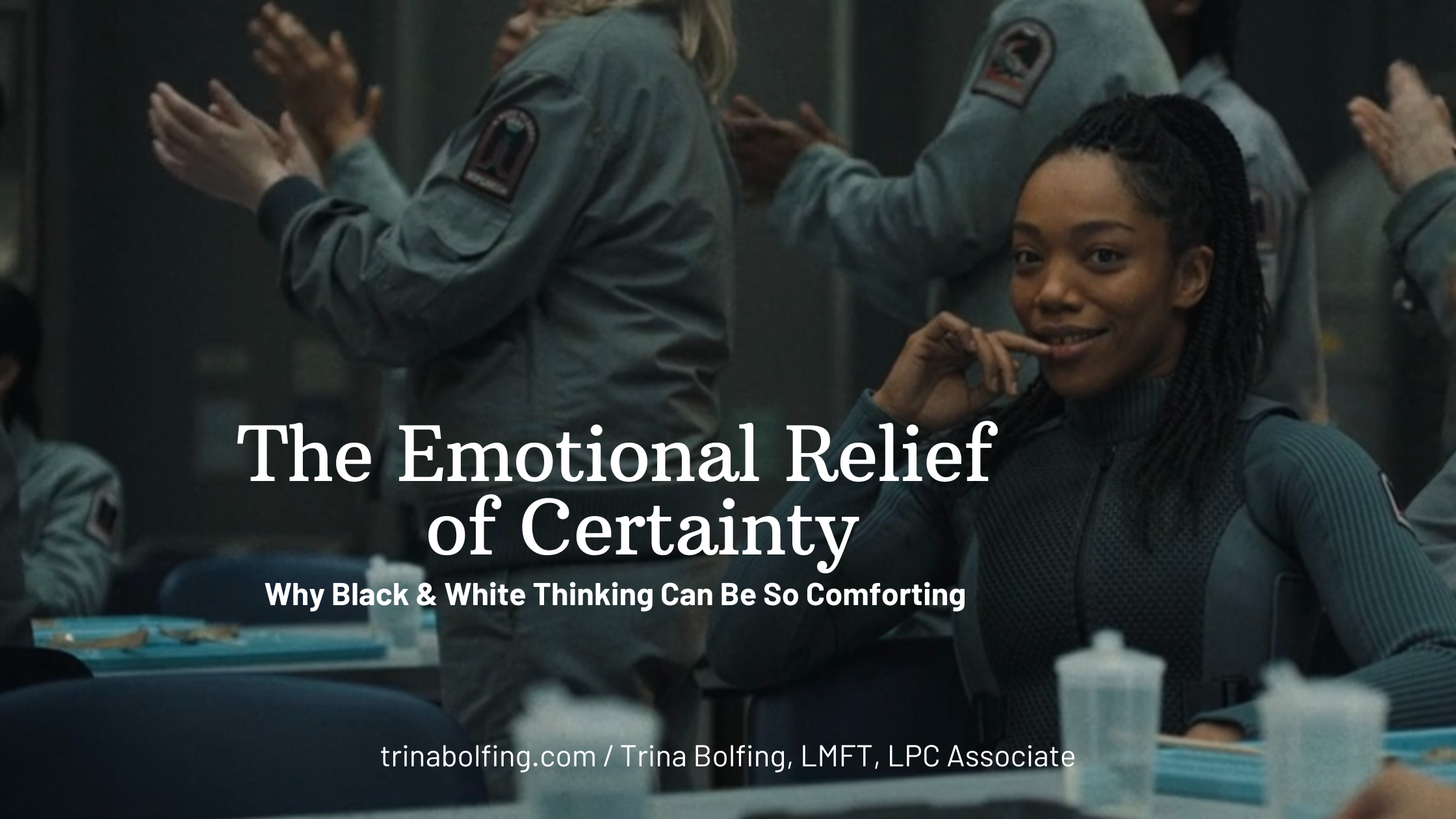
why certainty can feel safer than ambiguity
Have you ever heard the phrase “Do you want to be right, or do you want to be married?” I heard it for the first time in the movie Celeste and Jesse Forever (which is not today’s film, but perhaps one for a future post), and it has really stuck with me, especially now that I’m a couples therapist. Insisting on our own rightness can serve lots of purposes, one of which is that it protects us from the discomfort of uncertainty. We choose our side, and now we don’t have to sit in a gray area where the facts and their implications are still sorting themselves out. There’s a reason lots of us engage in black and white thinking: certainty is often much more comfortable than ambiguity.
“certainty is often much more comfortable than ambiguity”
Committing to our point of view can extend far beyond the bounds of a disagreement. We all have internal shortcuts we rely on to make snap judgments, not all of which are accurate. When we start using these shortcuts to draw conclusions about people is when we can risk flattening someone into their basest character traits, rather than seeing them for who they really are. I am certainly not immune to this tendency, and it’s something I’ve been mulling over a great deal since watching Bong Joon Ho’s Mickey 17.
Last week I shared my first post about this film in which I reflected on why our self-worth may struggle to recover after trauma. In today’s post, I’ll be focusing on my personal reaction to one of the characters – Nasha, Mickey’s girlfriend. I had a real-time reaction to her the way most of us can react to actual people, which is that I jumped to a conclusion about who I perceived her to be, instead of sitting in my own discomfort about not understanding her.
A reminder about the plot of Mickey 17: Mickey and Nasha are part of a crew of people who are on a spaceship headed for the planet Niflheim to start a new colony off-Earth. Mickey is what’s called an Expendable, which is a person who can be killed repeatedly, then re-printed as an exact copy over and over again. The researchers on the spaceship use him for experiments, then print a new Mickey when he’s inevitably killed by their current experiment. Nasha, on the other hand, is a security agent. Spoilers up ahead! And trigger warning for a brief description of gun-related violence.
how we flatten people into simpler stories
I wish I could say I felt ambivalent about Nasha for much of this film. Initially I thought highly of her. In her first scene, she sees Mickey is sitting alone with the look of someone who has been ostracized (which he was, as an Expendable) and waves him over to sit with her. Then we get to watch a montage of scenes with the two of them at the beginning of their romantic relationship. It’s sweet and a little spicy. Mickey tells us “Those four years [traveling to Niflheim] would have felt like forty if it weren’t for Nasha. She stayed with me in the best of times and kept by my side in the worst of times.”
Then in another scene shortly thereafter, Mickey describes what it’s like being bullied by some of the other shipmates and says “Imagine spending years elbow to elbow with these bozos. It was enough to push anyone over the edge.” Meanwhile, Nasha strolls into the scene and stands behind one of the bozos with a giant grin on her face, then holds a gun to one of their heads. “Sometimes even Nasha who is a model citizen would have to step in and remind us” [Nasha cocks handgun] “that we were all one big happy family.”
The scene devolves into chaos with Nasha pointing a gun at this person, then that. She looks unhinged. This scene was where my good opinion came into question, and I began to see her as a controlling person.

Nasha demonstrating how chaotic and unsettling she can be
Later in the film, the titular Mickey 17 survives a fall that the crew assumed killed him, which prompts them to print Mickey 18. Nasha takes this opportunity to try to have sex with both of them, making Mickey 17 very uncomfortable. I felt unnerved by her in this scene, which bolstered my new distaste of her. I found myself storing up several other small moments where she behaved in a way I didn’t like. I suppose I wanted to have a bank of evidence to back up my opinion.
what happens when someone resists our assumptions
But as I said – I wish I could say I were ambivalent about Nasha. This post is about it being easier to make snap judgments about people than to take in the whole of them and sit in the uncertainty. In the end, my bank of evidence was not reflective of who Nasha is, so I found myself having to reckon with information about her that didn’t fit into the characterization I’d created.
I could go scene by scene charting out Nasha’s character development, and when she ultimately proved her goodness. I could say that in this part of the movie she was a good person, then she went through a period where she wasn’t, then she achieved redemption in this other part of the movie – but I think I’d be missing the point. There wasn’t a redemptive narrative arc for her, she was always exactly who she is. She was always good and loving and loyal. She was always controlling and chaotic. She was always going to make choices I didn’t agree with. She was always going to make me uncomfortable. She was always going to remain committed to her values, without regard as to whether they were popular.
All of the good and the alarming and the complicated co-exist within her, all at the same time. The film wasn’t leading us toward a more perfect Nasha, she was fully baked from the get-go.
I want to be careful in avoiding sending a message that everyone is ultimately good at their core. It’s too simplistic and even in this film there are legit villains. Nasha just isn’t one of them. She’s one of the good guys, if there is such a thing. Nasha ended up feeling like a fully fleshed out person, not just a character in a film because just like a real person, she behaved in ways that made sense based on who she is. She didn’t behave in ways that felt scripted in order to evoke a specific reaction from me.
the emotional relief of deciding we’re right
What does it say about me that I was so quick to assume I knew Nasha based on a couple of scenes that bothered me? There’s some low-hanging fruit here, to be sure – I was watching a movie for enjoyment, not meeting an actual person, so I wasn’t bringing my social A game.
But her inconsistencies also made the story I was watching become much less clear. She made me feel like I no longer knew where it was going or what point it was going to try to make, which made me feel uneasy. About halfway through the film – the point when Nasha tries to hook up with both Mickeys – I paused it and had to finish the movie later because I felt like I had no idea where this movie was going, which felt emotionally exhausting in the moment.
Being able to commit to my judgment about Nasha meant there was one fewer element of the film that was a question mark. It’s temporarily regulating to grab onto the first thing we can find that will assuage our anxiety. The feeling of calm I gave myself at judging Nasha made me feel more at peace, and falsely gave me the impression I was right about her. Experiencing that relief – instead of being willing to allow Nasha, or someone like her, to be confusing – kept me from truly seeing her.
why truly seeing people means tolerating complexity

Nasha ultimately saves the day and becomes a trusted voice on Niflheim
Using Nasha as an object to ease my discomfort at her ambiguity only worked for so long, however. She ultimately saves the day in her own loud and abrasive and ethical way. What good would it do for me to dig in my heels and decide I still disliked her, despite overwhelming evidence of her goodness – and effectiveness. It was never her job to make me feel comfortable.
Thank you for reading! I’m Trina, and I’m a therapist in Austin, Texas. I write about movies, TV shows, & other media that reflect the kinds of patterns, relationships, and questions my clients are exploring in therapy.
I wrote this post myself, drawing on my own ideas and clinical perspective. I occasionally use AI to help me with things like titles, keywords, and SEO. But the reflections are always mine.
If you’re in Texas and looking for therapy, I’d love to connect and hear more about your story.