feeling like you’ve wasted your potential (even though you haven’t)
This post is the second of two about the film The Kid Detective. Check out the whole series.

I’m back today writing another post about the film The Kid Detective, directed by Evan Morgan. If you didn’t catch my last post, I wrote about complex trauma and how well this film portrays it on screen. Today I’ll be reflecting on the long-term impact of hanging your hat on an identity that’s thrust upon you at a formative time in life, before you know who you are for yourself.
For Abe – the hero of the film – it presents as gifted kid syndrome. If you’ve ever sat with that feeling that you’ve somehow wasted your potential, you might connect with Abe. And spoiler alert – but not really: no, you haven’t wasted your potential, and neither has Abe. But also yes there are actual spoilers up ahead, the kind related to the plot of this film. Head’s up!
when your identity is chosen for you
The Kid Detective centers around Abe Applebaum who, in present-day, is a 32 year-old private detective. Abe started his private detective business when he was 12, and the cases he’s solving today look pretty much the same as they did then. Cases like finding who stole a silver brooch from an 11 year-old’s birthday party. Or figuring out whether a local tween played baseball with the Mets over the summer as he’s been claiming. Or can you please find my cat?
Abe’s stuck, clearly, and the reasons he’s so stuck are complicated. Last week I talked about how complex trauma plays into where he has ended up. But even without the impact of complex trauma, Abe wasn’t exactly on a path leading to success, despite how things used to seem.
still living the story you started as a kid
His hometown of Willowbrook was enamored with the 12 year-old prodigy they perceived him to be. He’s not misunderstanding their collective awe of his investigative skills: even the local constable consults with Abe on cases. The town crowdfunded a private office for him that he works out of to this day, and his wall is plastered with decades-old newspaper articles singing his praises.
Abe’s choice of office decor isn’t the only part of his life that hasn’t matured – his investigative skills haven’t either. The way he solved the mystery of the silver brooch was by asking which of the birthday girl’s friends had the most cake. “It’s an old trick,” adult Abe tells her. “When you answer a question like that, your memory becomes extremely selective. You’re really telling me who you trust the least without even knowing it.”
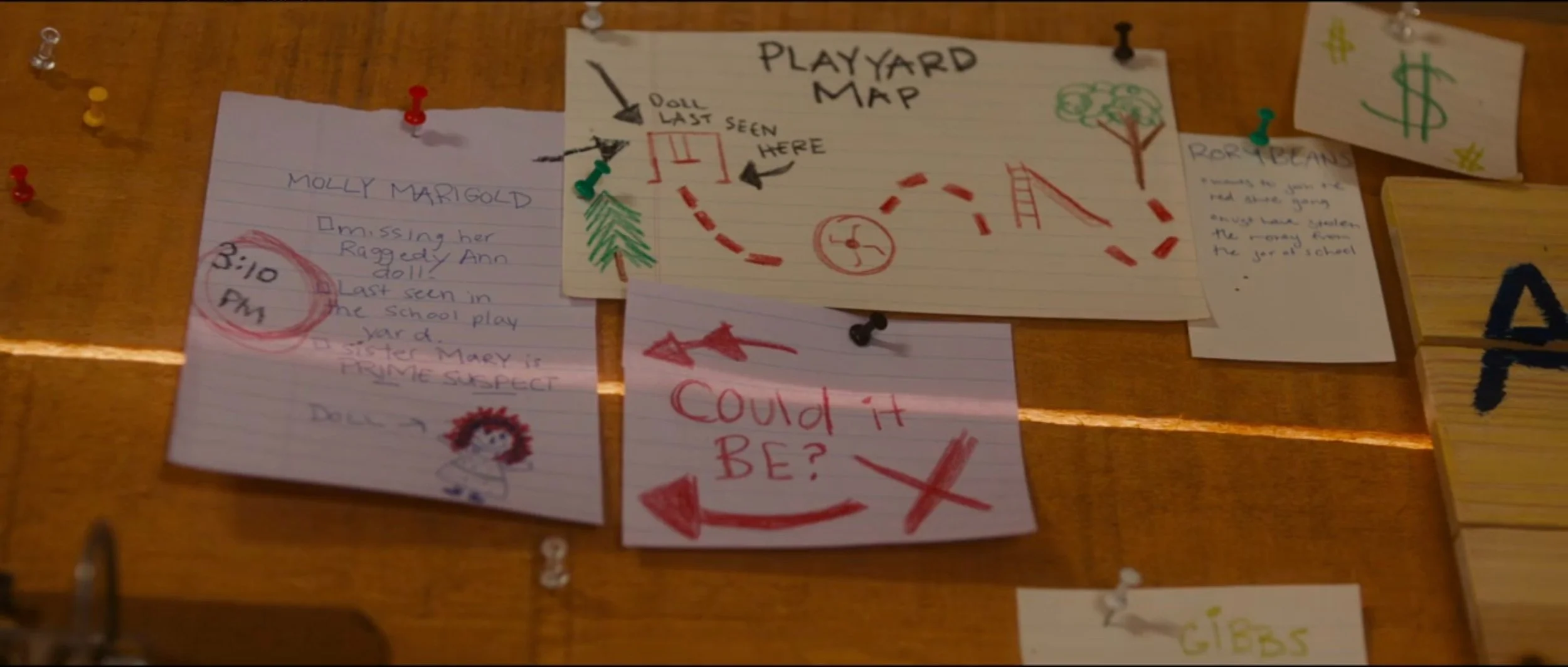
Adult Abe’s investigative skills aren’t that different from these scraps from childhood
Last week I described Abe as grown-up Encyclopedia Brown, and this kind of logic is a great example. He uses simplistic short-cuts to solve mysteries. And Abe often actually refers to them as “mysteries” or with a title that begins with “the case of.” The plot of this film thickens when Abe is hired for his first-ever murder case, and his family is understandably alarmed, given their familiarity with his investigative style. When Abe’s dad insists that Abe is not qualified to work this case, Abe responds “I’ve solved over 200 mysteries.” He goes on to say “I solved the case of the missing time capsule when I was 12 years old! The mayor gave me the key to the fucking city!”
when the world feels simpler than it is
Abe’s word choice is meaningful because a matured investigator would certainly know that the world is not so kind as to lay clear-cut whodunits straight out of Clue at his feet. It takes more to solve a true mystery than deductive reasoning based on vague, unproven theories, and you don’t need to be a detective to know that.
In a montage of scenes early in the film that show us evidence of his brightness at a young age, adult Abe’s voiceover says, “Whenever we watched movies as a family, I would always spot the bad guy and guess the ending in the second act.” This recollection is sandwiched between scenes of mystery-solving, which communicates to us that Abe believes his ability to guess the end of a movie is as evidential of mystery-solving acumen as the real-life mysteries themselves. His adult self lacks the insight to know that the mysteries in old black and white films are not as sophisticated or complex as the real thing.
It’s hard to know when this kind of insight should set in. If a kid wants to be a PI when he grows up because he guesses the end of every Hitchcock movie he watches, amazing! All of our inspiration comes from somewhere. But when a grown man believes the same, it’s hard to take him seriously. What version of this person – between the inspired kid and the immature adult – should have figured out that the world demands we adapt to its complexity by becoming more complex ourselves?
“the world demands we adapt to its complexity by becoming more complex ourselves”
when everything stops working
As Abe moves through his hero’s journey in The Kid Detective and begins to grow, he contemplates this very issue: “The people in this town used to look up to me. Even the adults. I was so far ahead of the game and then one day I just woke up behind.” This scene is the beginning of Abe’s growing willingness to take an honest look at himself and the world around him. It’s when he stops trying to overlay childhood praise over his adult life. Finally a sense of ownership of his own story begins to grow, and it’s no longer the simplistic fairytale that was sold to him as a kid.
It’s humbling, and I felt for him as I watched. In his turning toward maturation, there’s a moment when Abe guesses the end of a movie incorrectly. Then a short while later, it’s revealed that when he solved one of his earliest mysteries – one that has been a proverbial feather in his cap all these decades – he was wrong. He begins to realize the world has never been as simple as he thought it was.

The moment when the truth was revealed: Abe was wrong about The Case of Who Stole The Fundraiser Money all those years ago.
potential that was never really yours
When the adults around his young self were supposed to help him learn to adapt to the world, they instead gave him the impression he had already conquered it. It’s a message Abe must unlearn before he can slough off the weight of feeling like he wasted his potential — like his life no longer matches who he thought he’d be. Ultimately, all of that praise piled on so early in life wasn’t really about Abe. It was about everyone around him yearning for a simpler world and placing that hope on his shoulders.
you didn’t waste your potential
In many ways, the closure of this film is a beginning for Abe because fighting for his own relevance is what equips him to live differently going forward. He’s no longer burdened with being the object of everyone else’s hopes. When Abe finally unmasks the story’s villain in an unpredictable plot twist, the villain says “We both know how it feels when nobody takes you seriously. Now they’ll know what we were capable of.” There was never a potential that Abe failed to realize: he just never had the chance to decide for himself what that potential should be, until now.
Thank you for reading! I’m Trina, and I’m a therapist in Austin, Texas. I write about movies, TV shows, & other media that reflect the kinds of patterns, relationships, and questions my clients are exploring in therapy.
I wrote this post myself, drawing on my own ideas and clinical perspective. I occasionally use AI to help me with things like titles, keywords, and SEO. But the reflections are always mine.
If you’re in Texas and looking for therapy, I’d love to connect and hear more about your story.