nope (2022) & the pressure to laugh things off
This post is the second of two about the film Nope (2022). Check out the whole series.
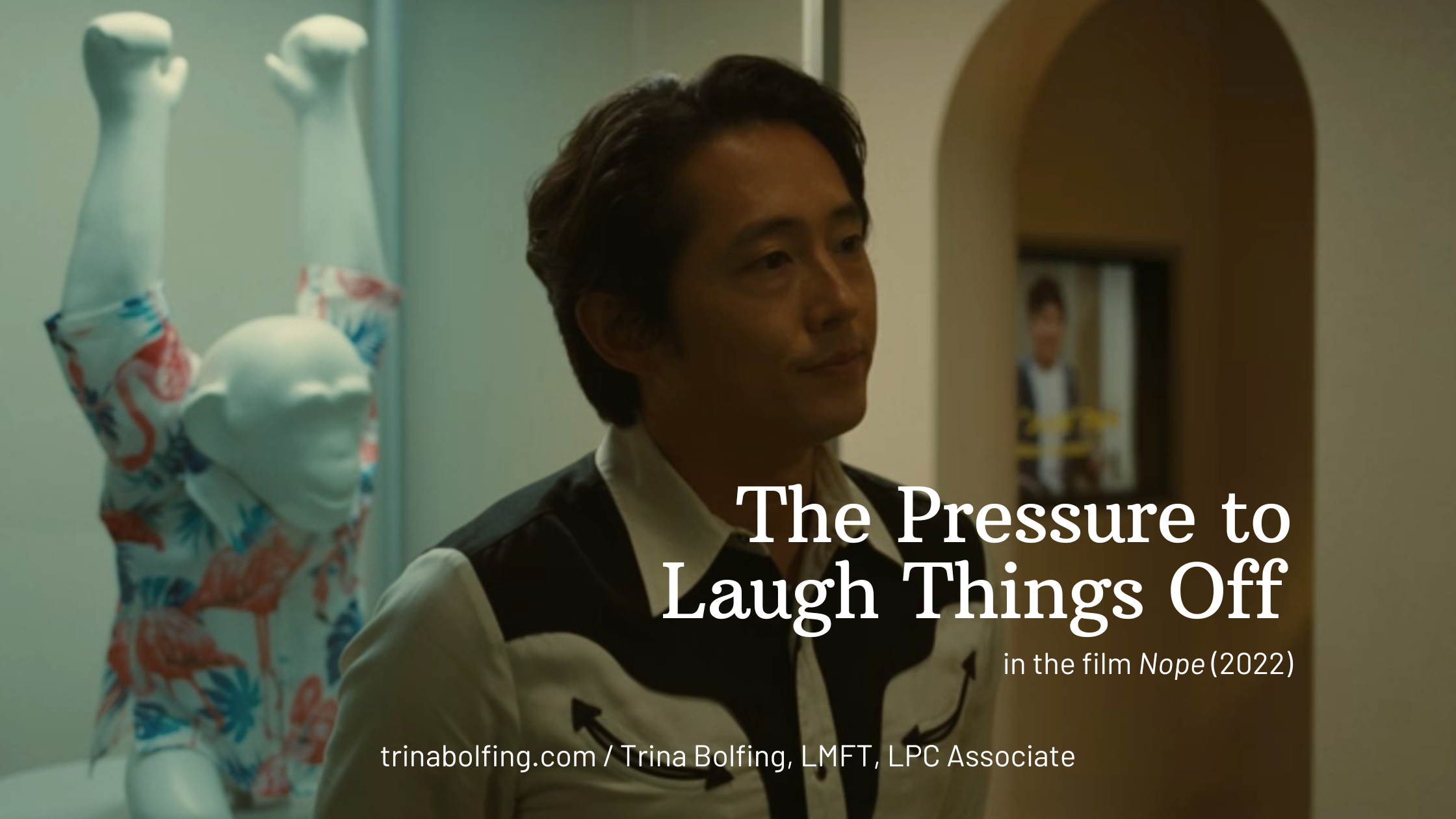
the “official” version of what happened
In writing today’s post, I’ve been contemplating family stories and the roles we each play within those stories. When a story is official canon for a family, there’s an accepted version that everyone re-tells. Maybe some small edits, but after years of sharing it, the story is scripted. Today’s reflection made me think about how different those stories would be if the perspective shifted.
What if a funny retelling of a misunderstanding were told from the viewpoint of a family member who had their feelings hurt? The story would lose its value because it would instead ask us to reckon with the hurt feelings that often accompany misunderstandings. Many of us choose to downplay that part of the story because we’re carried along by familial enthusiasm for what has become the official narrative.
Today’s post is my second about the film Nope, directed by Jordan Peele, and I’ll be addressing this very phenomenon – the tendency to laugh off our own feelings when something we’ve been through somehow becomes shared property.
If you’ve never seen Nope, it has an unusual narrative structure in that there’s a story-within-a-story that can stand on its own, without ever getting into the meat of the rest of the film. My last post centered around the main characters – OJ and Emerald Haywood – and their experience with an alien predator. Today’s post is about a secondary character in the film – Jupe Park – who is the lead in his own story, unrelated to the alien. This post will also touch on animal violence that can be upsetting, so trigger warning and take care.
when trauma becomes entertainment
Despite Jupe’s storyline being secondary and mostly separate from the alien encounters, it’s an unforgettable part of the film that many moviegoers feel stuck with after watching. Jupe was a child actor, most famous for starring in a short-lived TV show called Gordy’s Home. It’s a classic 90s-era family sitcom style show, with the titular Gordy being a chimpanzee.
In one episode, the cast was to be celebrating Gordy’s birthday. After a birthday-party-balloon unexpectedly pops, the chimp playing Gordy is startled into violence, attacking and mauling crew members for several minutes – “six minutes and 13 seconds of havoc” to be exact – until he is finally shot and killed. Young Jupe hides under a table, watching the entirety of the incident unfold.
Today, Jupe runs a small amusement park neighboring the Haywood family ranch. His office is dedicated to his childhood acting career, with most of the memorabilia from the Gordy incident which became a national sensation at the time. “It was a spectacle,” Jupe says. “People were just obsessed,” and the obsession persists into the present day. One couple paid Jupe $50,000 to spend the night in a private room with the Gordy-themed ephemera.
the pressure to laugh things off
Jupe’s experience is unusual: most of our most traumatic moments don’t capture the imagination of millions of people and become a pop culture phenomenon. But there is a relatable element here in that most of us know what it’s like to feel pressured to adopt the accepted version of events, even if it conflicts with our personal experience.
For Jupe, he has chosen a path of lightheartedness and joining the cultural zeitgeist around Gordy. When OJ and Emerald visit his office to negotiate the sale of a horse, Emerald peppers Jupe with questions about the film posters and trinkets displayed around the room. But it’s when she finally makes the Gordy connection that Jupe’s face changes, and he pauses the negotiations. He leaves his desk and takes the siblings on a tour of an entire room devoted to Gordy’s Home, a room to which Jupe normally charges an admission fee.
We would be pardoned in thinking Jupe is unbothered by revisiting these memories. He puts on a very convincing act as he shares the early successes of Gordy’s Home. But ramping up to tell the story of Gordy’s birthday episode, he says, “Then, uh, one day” followed by one of those throat clears many of us use when we’re trying to keep our feelings in check. “Then, uh, one day [pause, throat clear] we were shooting an episode...” The throat clearing is almost one and the same with the word it precedes. It’s not as easy a story to tell as Jupe would like us to think.

Jupe is very convincing at being unbothered by the story he is sharing.
“So what happened really, man?” Emerald asks Jupe, to which he responds “You haven’t seen the ‘Bad Gordy’ sketch on SNL? I mean that pretty much nailed it better than I could.” A far cry from my last post about being witnessed, Jupe prefers to outsource the story, and to a comedy show no less.
What a strange experience to have your trauma co-opted by other people. Watching the graphic Gordy scenes unfold, I could definitely imagine a story like that being fodder for jokes. A bloody chimp, wearing kids’ clothing and a party hat, viciously attacking people. The SNL sketch practically writes itself.
what happens when your feelings aren’t taken seriously
It’s as though the story stopped being Jupe’s the moment it happened. It was too sensational for people to understand its realness. So Jupe went with it.
When everyone around us has a particular reaction to something we’ve been through, and our feelings are completely different, we often make the choice to subsume our own experience in favor of the majority. It protects us from violating social norms, which in this case, dictate that we see the Gordy incident as a mesmerizing catastrophe, removed from individual experience. The Gordy incident now belongs to all of us, so Jupe’s feelings are outvoted.
There are all sorts of reasons that the Gordy story stands out to people when they watch Nope. It’s completely divorced from the rest of the storyline, which elevates it, asking us to be curious about why it’s part of the film at all. It’s part of an ongoing theme of animal wildness throughout the film. But for most of us, animal wildness isn’t what keeps Gordy front of mind.
It is truly upsetting to watch those scenes and to listen to the audio. We have access to the private scene that played out, whereas the rest of the world just saw the headlines, so many people cannot grasp that there is absolutely no humor in what happened.
Most of us know what it’s like to go through something genuinely upsetting, only to have it minimized, brushed aside, or turned into a running inside joke. It can feel fruitless to insist that people try to understand what you went through – what if you shared how you really felt, in all your realness and vulnerability, and they still thought it was a funny story?
Thank you for reading! I’m Trina, and I’m a therapist in Austin, Texas. I write about movies, TV shows, & other media that reflect the kinds of patterns, relationships, and questions my clients are exploring in therapy.
I wrote this post myself, drawing on my own ideas and clinical perspective. I occasionally use AI to help me with things like titles, keywords, and SEO. But the reflections are always mine.
If you’re in Texas and looking for therapy, I’d love to connect and hear more about your story.